Satan’s Chosen People
The West Bank’s last Christian village under settler attack
The Telegraph witnesses settler violence despite areas being under IDF protection
Henry Bodkin 23 August 2026 6:43am BST
The Israeli settlers always come at sunset, their approach sending the inhabitants of the remote farmsteads into a quiet panic.
They arrive on noisy off-road vehicles, on foot, sometimes on horseback. They throw stones, break windows, set fires and occasionally, residents end up in hospital from their savage beatings, or worse.
In Taybeh, the last entirely Christian town in the West Bank, The Telegraph witnessed an attack in which a local Bedouin family were pinned down for more than an hour last week.
The town, which is close to Ramallah, has been declared a “closed military zone” by the Israel Defense Forces (IDF) after months of settler attacks. The Telegraph previously reported that the settlers had used leaf blowers to fan the flames they had set to intimidate the town’s Christian inhabitants.
Despite this IDF order, attacks continue unabated and the town is increasingly surrounded by illegal outposts built by Israeli settlers.
The sound of an approaching settler incursion is always the same – a melee of barking dogs and mothers tersely ordering their children inside while the men shout “wein, wein” (meaning “where, where?” in Arabic), as they try to spot the intruders among the olive trees.
It is the sound of fear.
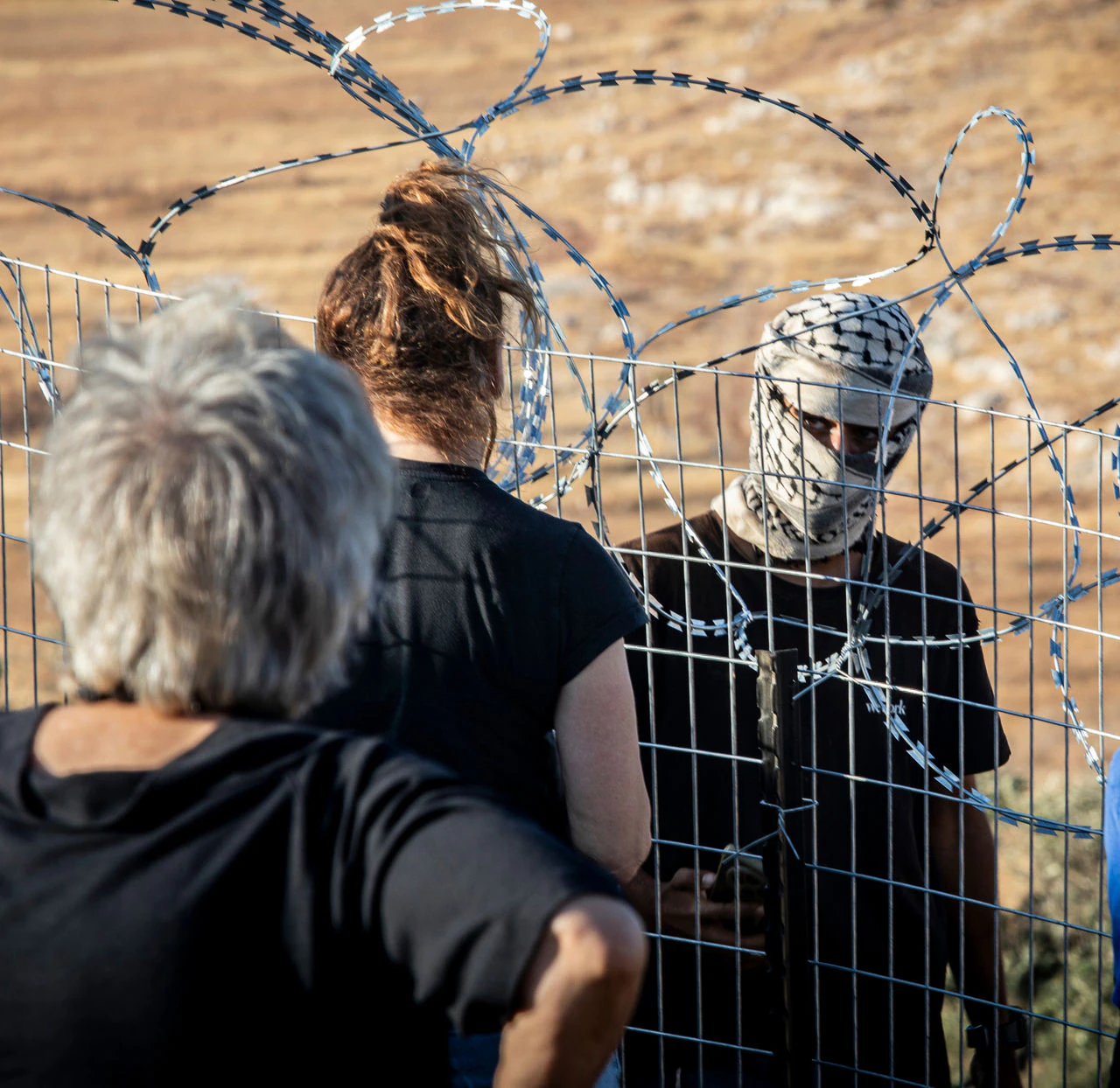
“Last week, we had a weaker fence and they got in,” said Naif al-Kaabneh, pointing to the newly installed coils of razor wire that surround his small compound near Taybeh. “Now, we’ll see.”
Photo caption: Nayef al-Kabneeh says Israeli settlers surround his small compound three times a day
While settlers tried to break through the new barrier, the 54-year-old mutters: “There is no justice. If there was justice, we wouldn’t be living through this.”
In the end, the fence held up and – perhaps because of the presence of journalists – the masked intruders made do with hurling rocks.
“It’s the constant stress, they come three times a day,” said the father. “We don’t sleep at night. There is always someone on watch.”
Attacks like these are rampant across the West Bank.
A few days before visiting Taybeh, The Telegraph was caught up in another evening assault – this time in the village of Qusra – that villagers miraculously repelled.
Last year in the village, the masked settlers shot one Palestinian dead and left his brother paralysed after stabbing him in the leg.
Settler violence in Taybeh and Qusra persists, despite the IDF declaring them closed military zones, ostensibly to protect Palestinians.
But residents claim that, in reality, the orders are issued to give the outside world the impression that Israel is taking action, while using them to prevent international monitors and media accessing the areas.
In other words, to protect the settlers.
Video footage obtained by The Telegraph appears to bear that out, with Israeli soldiers recorded on camera saying they had no intention of removing the settlers.
Arik Ascherman, an Israeli rabbi and leader of Torat Tzedek-Torah, a human rights group, was standing on the hill above the al-Kaabneh home before the attack.
“What’s new now, what I’ve never seen before in 31 years of doing this, is state support not just for settlers, but for settler violence, to help them take over,” he said.
“They know that the most effective way to drive Palestinians out is through new shepherding outposts. Each one dominates the land around it.”
In Taybeh, the streets were all but silent.
The village, where Jesus is believed to have visited after raising Lazarus from the dead, has suffered repeated arson attacks in the past year, including an attempt to burn down its Byzantine-era church.
The annual beer festival hosted by Taybeh’s brewery will not take place this October because of the risk of attacks from settlers.
“They drive right up into the village to intimidate us,” said Madees Khouri, 40, the daughter of the brewery’s co-founder.
“Every month we ask, ‘Is this the worst that can happen?’ Then it gets worse.”
“The settlers are given the green light by the government to do whatever they want. The closed military zone is no protection for us.”
Since 2022, the extreme wing of the settler community has had friends at the top of Israel’s government.
Bezalel Smotrich, Israel’s finance minister who also holds a position in the ministry of defence, and Itamar Ben-Gvir, the national security minister, have long spoken of their dream of ethnically cleansing Arabs from the West Bank and Gaza.
Recent figures indicate they are some way to achieving it.
Earlier this year, the UN said that 38 Palestinian communities had been entirely emptied of their populations since 2023.
Between January and June this year, 2,200 Palestinians were displaced after attacks affecting 230 different communities, with hundreds more looking for shelter because of demolitions sanctioned by the authorities.
With the polls looking tough for Benjamin Netanyahu’s Right-wing coalition at the election on Oct 27, many in the West Bank feel the violent settlers want to seize as much ground as possible in case they lose their top-level backers come autumn.
“Since Oct 7 [2023], it has been really bad, but now they’re going even faster ahead of the election,” said Mr al-Kaabneh.
Just as the rate of attacks has increased in the last four years, so too has the Israeli state’s response changed.
This is why what has become known as the “siege of Qusra” has broken through the morass of daily reports of West Bank violence and seized international attention.
On Aug 9, a large group of settlers isolated a handful of Palestinian homes from the village, blocking the road and severing the electricity and water supplies, as well as building illegal structures nearby.
Photo caption: Settlers establish control over Palestinian areas with illegal shepherding outposts
Approximately 15 residents were trapped inside their homes, including children.
The army was deployed and a closed military zone declared around Qusra.
But on the first attempt to remove some of the illegal structures, more than 100 settlers appeared and began placing boulders in the road, forcing the soldiers to back down.
Some of the illegal outpost structures have since been removed.
However, despite bolstering their forces with a fresh battalion, the IDF has not yet succeeded in moving all the settlers away.
They did, however, evict a number of Palestinian families, citing the closed military zone as an excuse. Some were allowed back, only to find that their homes had been allegedly robbed and vandalised.
Last week, The Telegraph, like other journalists, were prevented from approaching the besieged Palestinians in Qusra.
As an IDF officer painstakingly read out the wording of the order from his phone – a directive issued to remove law-breakers – the settlers could be seen roaming the hill less than 200 metres above him.
The soldiers seemed nervous around the settlers.
When, at one point, they saw one of the settlers’ SUV approaching the roadblock from within the cordon, they angrily pushed The Telegraph’s journalists back further down the road.
In the long years since the Oct 7 attacks, Mr Netanyahu has repeatedly lauded the IDF’s military prowess against Hamas, Hezbollah and Iran.
But those same soldiers seemed unable to remove a few dozen civilians, most of whom were unarmed.
Numerous videos and pictures that have subsequently emerged show the IDF and settlers loitering and, in some cases, praying together on the hillside.
“For the first time in my life, there is no law in the state of Israel,” said a father, who called himself Marma, who lives up the hill from Qusra. “We used to think of Israel as a state of laws.”
Abdul Azim al-Wadi, the mayor of Qusra, said: “We used to talk about good jaesh [army] or bad jaesh. It would change depending on the day. Today, it’s bad jaesh.”
The siege took on an international dimension when it emerged that, like many West Bank Palestinians, Louai Abo Ridi, the owner of one of the besieged homes, also has US citizenship.
Mike Huckabee, the US ambassador to Israel and a staunch supporter of the settlement project, described the siege as a “horrific act of terror”.
Insisting that he would have expressed concern even if no Americans were involved, he subsequently reinforced his message, describing the settlers involved as “Israeli terrorists”.
However, he went on to talk of “settlers” versus “unsettlers”, to distinguish between everyday Jewish residents of the West Bank and radical extremists, whom he described as a “very small minority”.
His comment echoes a popular argument from Israel’s centre-Right that the violence in the West Bank is mainly perpetrated by no more than 200 radical young people.
Palestinians and some observers remain sceptic of this claim, who point out that such a small number of people could not carry out the breadth and rate of attacks across the occupied territory.
While speaking to Marma at his home near Qusra later that day, an attack begins.
An all-terrain vehicle (ATV) bounces along the rocky landscape and, seemingly out of nowhere, a dozens of settlers appear at the top of the hill, some of them masked.
Last year, settlers shot Marma’s nephew dead, and his brother was left disabled after he was stabbed four times in the leg.
It was frightening to watch them approach the compound, not knowing if this was one of the times they would try to get in, not knowing whether they were armed, but knowing that a call to the police would yield no protection.
On this occasion, a group of young men from the village emerged and began to throw rocks at the settlers, eventually driving them back.
It was a risky gambit, as Palestinian stone-throwers are often deemed terrorists and are liable to be shot on sight.
Later that evening, an IDF patrol raided the compound, demanding to know the identity of the men who had taken on the settlers.
“They’re not human,” said Marma, referring to the settlers. “They know only to kill and break and burn. They come with their faces covered with knives and sticks.”
Shortly after the siege in Qusra began, an IDF spokesman described the settler attacks as “illegal, reprehensible and unacceptable activity”.
The IDF says it has dismantled illegal outposts.
In response to footage showing soldiers interacting and praying with settlers, the army said: “The security forces will continue to operate firmly and responsibly to improve the situation in the area, uphold law and order, and prevent the recurrence of such incidents.”
Britain has already sanctioned a number of individuals connected with West Bank violence, including Mr Smotrich and Mr Ben-Gvir.
Last week, Ed Miliband, the Foreign Secretary, threatened to roll out further sanctions in response to a new housing scheme east of Jerusalem that would effectively cut the West Bank in two for Palestinians, making it even harder to move around.
Israel is waiting to see if Andy Burnham will follow through Sir Keir Starmer’s plans to impose widespread economic sanctions against goods and services from West Bank settlements.
Diplomatic sources suggest that No 10 is minded to wait until after the Israeli general election.
According to the polls, Gadi Eisenkot, a former IDF chief of staff who is seen as a centrist figure, has the best chance of defeating Mr Netanyahu.
But the events in Qusra show just how difficult Israel’s military would find it to shut down settler violence, even if it was given the political direction to do so.
Last week, a small number of Palestinian or Arab civilians defied the IDF, forcing them to choose between using heavy-handed tactics against them, perhaps spilling Israeli blood in the process, and backing down.
The soldiers backed down.
There are indications that the use of closed military zones might not be sustainable.
On Friday, Israel’s central district court made the unusual decision to accept the appeal of an Israeli human rights activist – a former IDF colonel – who had been arrested after entering a zone near Nablus, a Palestinian city north of Jerusalem. In doing so, the court questioned the army’s apparent inability to detain settlers.
The violence is taking place against a backdrop of economic strangulation, thanks in part to the widespread road closures that have been put in place since Oct 7.
Ms Khouri says that if one of her beer delivery trucks can make it the short distance to Ramallah and back within a day, that is now a victory.
In the past, one truck could have delivered to numerous towns and villages in a single day.
Meanwhile Father Jack-Nobel Abed, of Taybeh’s Greek Malkite Catholic Church, spoke of his fears of a “third intifada” if the violence continues, of how hard he works to persuade the young Palestinian men of his congregation to be cautious and not to fight back.
“We don’t want martyrs in this village,” he said. “In the surrounding villages, they each have five or six martyrs, but not here.”
“They want to provoke a third intifada. But I tell people to be patient. We’re waiting to see if there is a light at the end of the tunnel.
“If there is, well, perhaps it will explode – into peace or war.”
The West Bank’s last Christian village is under settler attack
by Henry Bodkin
Jerusalem Correspondent
The Israeli settlers arrive at sunset to terrorise the inhabitants of the remote farmsteads.
In Taybeh, the last entirely Christian village in the West Bank, I witnessed an attack on one family that lasted for an hour.